



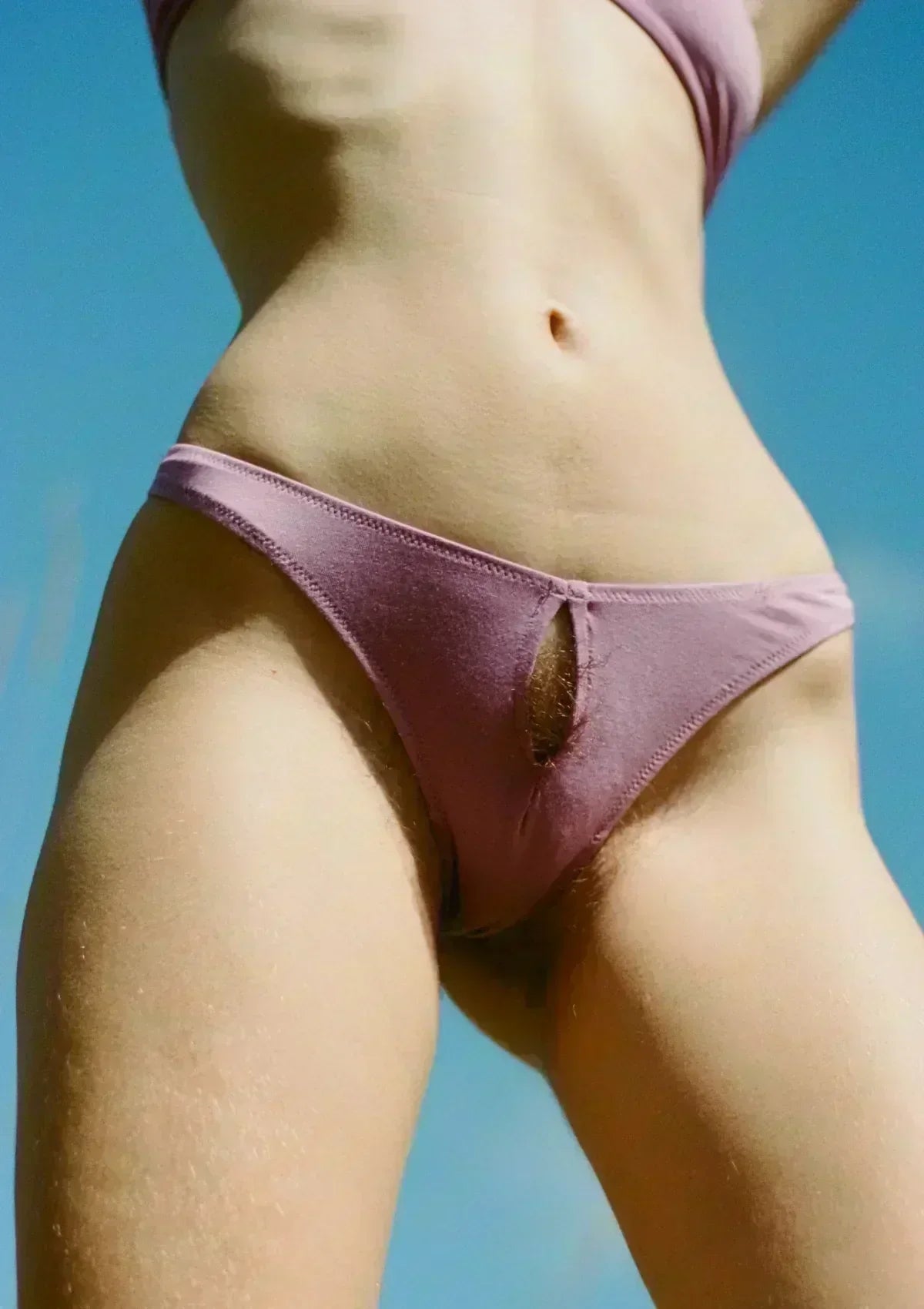
Over time, what begins as grooming becomes expectation. When women rarely see natural bodies reflected back to them, naturalness starts to feel like failure. Something unfinished. Something that needs intervention. This is how stigma embeds itself.
Slowly, invisibly, until the absence of hair feels normal and its presence feels confronting. The recent rise of faux hair thongs is a manifestation of this cultural milieu.


Synthetic faux hair thongs do not exist to serve the body. They exist to manage perception. They suggest that the appearance of natural hair is acceptable only when it is artificial, controlled, and removable. That visibility must be simulated rather than real. That the body can be referenced, but not actually shown.
There is also a deeper discomfort in wearing a synthetic stand-in for something that already exists on the body. It places performance above embodiment. A visual illusion where presence should be.

Beyond that, they introduce unnecessary friction, heat, and non-breathable components into one of the most sensitive areas of the body. From an environmental perspective, they rely on plastics and disposable novelty rather than longevity or care.

But the cultural cost is the greater one. Faux solutions do not free women. They keep the body at a distance. Freeing the bush is about autonomy. Not to insist on any one way of being. It is not about telling women to stop grooming or start grooming. It is about removing shame from the equation entirely.

The Real Bush G-String's intention is to create a totem that allows the body to exist without apology. Recognising that confidence does not come from disguise, but from acceptance. Choice is only real when all options are allowed to exist without judgement.

Women's bodies are increasingly treated as projects. Something to upgrade. Something to optimise. Something that should always be in progress. But bodies are not before-and-after images. They are lived-in, cyclical, and human. When we move away from correction and towards care, the conversation shifts. Comfort becomes valid. Breathability matters. Softness becomes a priority rather than an afterthought.
This is where design can either reinforce stigma or help dissolve it. Through garments that do not disguise the body or replace it with something synthetic. Through natural fabrics that breathe, soften, and move with the body as it is.

Stigma thrives where bodies are edited. Freedom grows where they are allowed to be seen. To free the bush is to step away from illusion and return to the body. Not as something to manage, but as something to inhabit. Nothing synthetic is required. Nothing needs hiding. The real bush is already enough.